Being From Nothingness
Section 4: The Emergence of Causality
4.1 The Problem of Time
We have developed a geometric framework—constraint space with its potential Φ, gradient ∇Φ, metric, and curvature—without assuming time. Yet we experience time: sequences, before and after, cause and effect. Where does this temporal structure come from?
The standard move in physics is to assume time as a background dimension. Events are located in spacetime; dynamics is motion through time; causality follows temporal ordering. But this leaves time unexplained—a primitive structure smuggled in at the foundations.
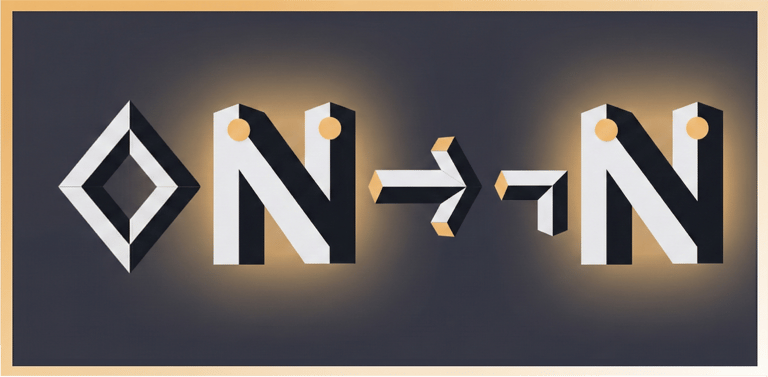
Our framework suggests a different approach: temporal structure emerges from the geometry of distinguishability when configurations have sufficient complexity. Time is not a container in which things happen; it is a feature of certain relational structures—specifically, those with N ≥ 3 distinguishable features.
This section develops this claim. We show that:
At N = 2, no ordering structure is possible—the configuration is inherently symmetric
At N ≥ 3, ordering structure becomes possible—asymmetry can exist
What we call "time" is the ordering parameter for configurations with non-trivial asymmetry
What we call "causality" is asymmetric constraint structure between features
The emergence is not temporal (that would be circular) but geometric: certain configurations have structure that others lack.
Section 4 of Philosophy Paper
Supporting Information further logical and mathematical argument for Section 4 of Philosophy Paper
Supporting Information further logical and mathematical argument for Section 4 of Philosophy Paper
Research
Exploring natural philosophy.
© 2026. All rights reserved.
Narrativium (Terry Pratchett), is a fictional, elemental substance representing the "stuff of stories" that gives fictional worlds purpose, direction, and coherence, acting as the glue holding narratives together.